Our Approach
Start small. Start early.
Four rules turn that into a page. They are deliberately narrow.
The gap
Children get entertainment or drills. Rarely science.
One kind of book is bright, loud and empty. The other drills letters and numbers. Both treat the child as a recipient.
The method
How a page gets built.
Isolate one idea
Not the solar system — Saturn. Not chemistry — one water molecule. A page offering three ideas delivers none.
Draw it accurately
Saturn’s rings sit at the correct angle. A water molecule has two hydrogens. This is the child’s first mental image and it should be right.
Let the fact do the work
“A peregrine falcon dives at 240 miles per hour. That is faster than a Formula 1 car, and it does it with its wings tucked in, falling out of the sky on purpose.” — No exclamation mark needed. The fact is astonishing enough.
Name it properly
Molecule. Orbit. Symmetry. Withholding the real word doesn’t simplify a subject. It removes the handle.
Leave room for the question
Every page is built to provoke something said out loud. That exchange is where the learning happens. The colouring is the occasion for it.
The instruction we print in every book
Let them color it wrong.
A purple Earth is a child who knows what Earth looks like. The colours are theirs. The shapes are ours. That is enough.
Why print
A crayon issues no notifications.
Colouring builds the motor control handwriting will need. A physical book puts two people on one page in one room. And nothing competes for attention.
Fact-checking
Every claim, against a primary source.
Where something could not be verified, it does not appear in the book.
Stated plainly
How our illustrations are made.
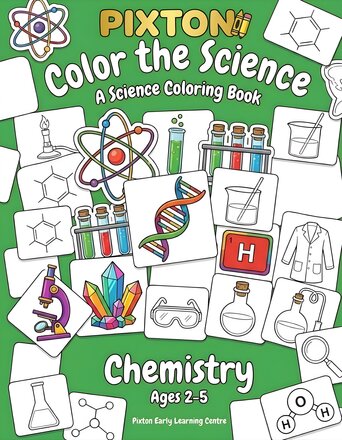
Our illustrations are generated using AI tools, then reviewed by a person for scientific accuracy and age-appropriateness.
We say so on our books and here because families are entitled to know how the material in their home was produced. All written content is human-authored.